Giacomo Sandri
Man on FireGiacomo Sandri is a criminal operative whose control of the prostitution business within his uncle’s organization gives him access to vulnerable young women. The novel also connects him to the kidnapping of Pinta: police identify Sandri and Giorgio Rabbia as collaborators in the crime, which Dino Fossella organized. Sandri’s role links an exploitative criminal enterprise to the plot’s central act of violence against Pinta.
Identity and Criminal Operation
Sandri is introduced in an intimate encounter with a fifteen-year-old girl while Violente waits in a black Alfa Romeo below. Sandri is pleased by her attention but regards her growing attachment as an inconvenience. His private conduct reflects the power he exercises through the organization: he controls its prostitution business and the routes by which young women arriving in the city are directed into bars, clubs, and brothels.
When Sandri notices a particularly young woman, he diverts her for his own use; when he loses interest, she is replaced. In the episode, he decides to pass the girl to Pezzutto, who will make her dependent on drugs and, through that dependency, more dependent on the organization. Sandri treats these decisions as routine business, priding himself on acting without emotion. His stated preference for ever-younger girls makes his exploitation a recurring practice, not an isolated abuse of authority.
Connection to Pinta’s Kidnapping
The police investigation establishes Sandri’s connection to the kidnapping through the known partnership between him and Rabbia. When Mario Satta recognizes the relevance of the Balletto case, he concludes that Rabbia and Sandri worked together in it and that Fossella organized it. The distinction matters: the investigation identifies Sandri as a collaborator, while assigning the organization of the operation to Fossella.
Pinta’s fate gives that connection its weight. The ransom was paid, and her release was expected that night, but a police sweep for a Red Brigades gang caused the kidnappers to hide for several hours. Pinta did not return; she was found the next morning in the trunk of a stolen car, and the autopsy determined that she had suffocated. The evidence does not specify what Sandri personally knew about the ransom arrangement or his precise actions during her captivity, but it places him among the men involved in the kidnapping that ended in her death.
Murder and Police Investigation
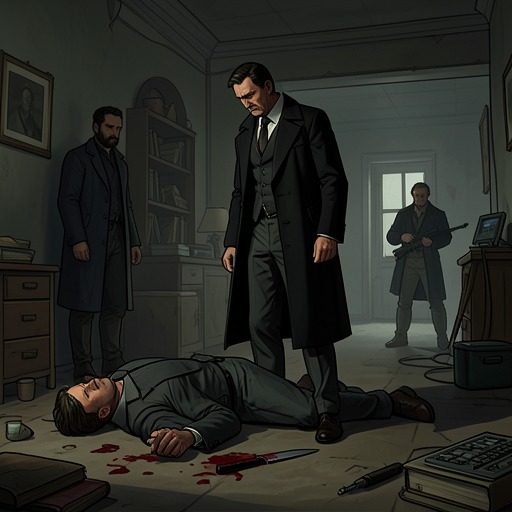
Sandri’s own murder is disclosed through its aftermath. A policeman finds him propped behind the wheel of a car, with one elbow sticking out of the window. When Sandri does not respond to an order to get out, the officer opens the door, and the body falls against him. The staging repeats the image of an occupant apparently waiting in a car, but the discovery makes clear that the man behind the wheel is already dead.
The murder sharpens the investigation into the earlier kidnapping. Satta and Massimo Bellu connect Sandri and Rabbia to the Balletto case and place Fossella at its head. Sandri’s death therefore serves both as the end of his role in the criminal network and as a clue that the kidnapping is being answered by a campaign against those responsible.
Narrative Role
Sandri’s chapters expose the routine machinery behind the organization’s exploitation: access to young women, their movement through controlled venues, and the use of dependency to keep them within its reach. The kidnapping investigation then reveals the same criminal world operating at a larger scale, with Sandri and Rabbia connected to the abduction and Fossella identified as its organizer. His murder closes his personal arc while making the consequences of that network’s violence impossible to separate from the pursuit of its members.